

The most trusted news from the United Kingdom
Provided by AGP
RFID Printers Market Size Worth US$ 2.7 Bn in 2026, Projected to Reach US$ 4.4 Bn by 2033 at 7.2% CAGR
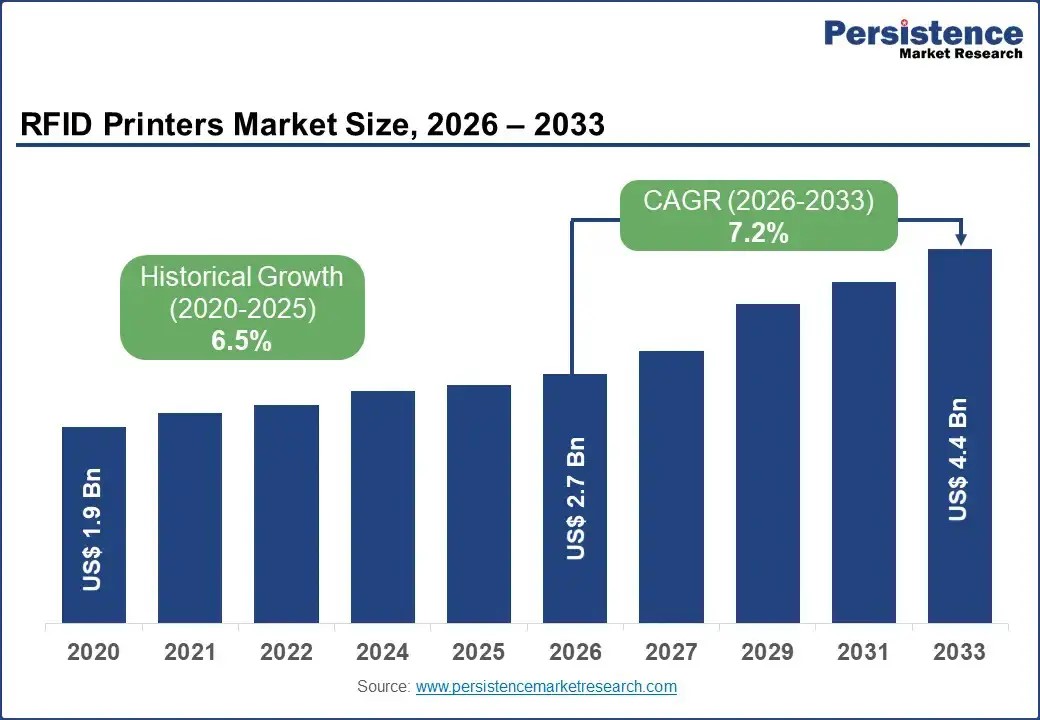
The global RFID printers market grows from US$ 2.7 Bn in 2026 to US$ 4.4 Bn by 2033, at a 7.2% CAGR during forecast 2026–2033
BRENTFORD, ENGLAND, UNITED KINGDOM, May 5, 2026 /EINPresswire.com/ -- The RFID printers market is growing steadily, projected to reach US$2.7 billion in 2026 and US$4.4 billion by 2033, at a CAGR of 7.2%. Growth is driven by rising adoption of automated identification systems across retail, healthcare, and logistics, where real-time tracking and operational efficiency are critical. Increasing demand for regulatory compliance, product traceability, and supply chain accuracy is further boosting market expansion, along with declining RFID tag costs and IoT integration.
Industrial RFID printers lead the market with a 58% share due to high-volume usage in warehouses and manufacturing, while mobile printers are the fastest-growing segment due to portability needs in retail and healthcare. Regionally, North America dominates with a 36% share, supported by strict regulatory mandates, whereas Asia Pacific is the fastest-growing region, driven by rapid industrialization, e-commerce expansion, and smart logistics initiatives in countries like China and India.
𝐆𝐞𝐭 𝐚 𝐒𝐚𝐦𝐩𝐥𝐞 𝐏𝐃𝐅 𝐁𝐫𝐨𝐜𝐡𝐮𝐫𝐞 𝐨𝐟 𝐭𝐡𝐞 𝐑𝐞𝐩𝐨𝐫𝐭: https://www.persistencemarketresearch.com/samples/17857
Market Segmentation
The RFID printers market is segmented based on product type, application, and resolution. In terms of product type, industrial printers account for the largest share due to their durability, high-speed encoding, and compatibility with enterprise systems such as warehouse management systems. These printers are widely used in large-scale logistics and manufacturing operations where continuous, high-volume printing is essential. On the other hand, mobile printers are gaining traction due to their portability and wireless capabilities, making them ideal for on-demand printing in retail stores, hospitals, and field operations.
From an application standpoint, retail and e-commerce dominate the market, driven by the need for accurate inventory tracking and efficient supply chain management. RFID printers enable item-level tagging, allowing businesses to track products in real time and reduce stockouts and shrinkage. Other key applications include healthcare, where RFID is used for patient identification and medication tracking, and logistics, where it enhances shipment visibility and operational efficiency.
In terms of resolution, the 300–600 DPI segment holds the largest share, offering an optimal balance between print quality and performance. This resolution range is widely used in healthcare and industrial applications where durability, readability, and compliance with standards such as GS1 are essential. Higher resolutions are used in specialized applications requiring detailed graphics and precision, while lower resolutions cater to cost-sensitive use cases.
Regional Insights
North America remains the dominant region in the RFID printers market, driven by strong adoption across retail, healthcare, and defense sectors. The United States leads the region, supported by regulatory mandates such as pharmaceutical serialization requirements and advanced logistics infrastructure. The presence of major retailers and technology providers further accelerates adoption, making North America a mature and high-value market.
Europe represents a significant market, characterized by strict regulatory frameworks and a strong focus on sustainability and traceability. Countries such as Germany, the UK, and France are leading adopters, particularly in manufacturing, retail, and healthcare sectors. The region’s emphasis on compliance and environmental responsibility drives the adoption of RFID technologies for product lifecycle tracking and anti-counterfeiting measures.
Asia Pacific is the fastest-growing region, fueled by rapid industrialization, expanding e-commerce, and government initiatives promoting digital transformation. China dominates the region due to its large manufacturing base and strong supply chain infrastructure, while India is emerging as a key growth market supported by pharmaceutical exports and retail expansion. Southeast Asian countries are also witnessing increased adoption due to rising trade activities and smart logistics initiatives.
𝐃𝐨 𝐘𝐨𝐮 𝐇𝐚𝐯𝐞 𝐀𝐧𝐲 𝐐𝐮𝐞𝐫𝐲 𝐎𝐫 𝐒𝐩𝐞𝐜𝐢𝐟𝐢𝐜 𝐑𝐞𝐪𝐮𝐢𝐫𝐞𝐦𝐞𝐧𝐭? 𝐑𝐞𝐪𝐮𝐞𝐬𝐭 𝐂𝐮𝐬𝐭𝐨𝐦𝐢𝐳𝐚𝐭𝐢𝐨𝐧 𝐨𝐟 𝐑𝐞𝐩𝐨𝐫𝐭: https://www.persistencemarketresearch.com/request-customization/17857
Market Drivers
The rapid growth of e-commerce and retail automation is a major driver of the RFID printers market. As businesses strive to improve inventory accuracy and enhance customer experience, RFID technology provides a reliable solution for real-time tracking and data visibility. Large retailers are increasingly mandating RFID tagging across product categories, driving demand for RFID printers to produce encoded tags on demand. Additionally, regulatory requirements for product traceability in industries such as pharmaceuticals are further accelerating adoption. These regulations require companies to implement serialization and track-and-trace systems, making RFID printing infrastructure a critical component of compliance strategies.
Market Restraints
Despite its growth potential, the RFID printers market faces challenges related to high initial investment and technical limitations. The cost of industrial-grade RFID printers and associated infrastructure can be significant, particularly for small and medium-sized enterprises. In addition to upfront costs, ongoing expenses such as consumables, maintenance, and system integration can increase the total cost of ownership. Technical challenges, including signal interference from metals and liquids, can also impact RFID performance and reliability. These factors may deter adoption in certain industries and regions, particularly where cost sensitivity and environmental constraints are high.
Market Opportunities
The integration of RFID technology with IoT and Industry 4.0 ecosystems presents significant growth opportunities for the market. Smart RFID printers equipped with cloud connectivity and analytics capabilities can provide real-time insights, enabling businesses to optimize operations and reduce downtime. Additionally, the healthcare sector offers substantial growth potential, as hospitals increasingly adopt RFID solutions for patient identification, medication tracking, and asset management. These technologies not only improve operational efficiency but also enhance patient safety, making them a valuable investment for healthcare providers undergoing digital transformation.
𝐁𝐮𝐲 𝐍𝐨𝐰 𝐭𝐡𝐞 𝐃𝐞𝐭𝐚𝐢𝐥𝐞𝐝 𝐑𝐞𝐩𝐨𝐫𝐭: https://www.persistencemarketresearch.com/checkout/17857
Company Insights
• Zebra Technologies Corporation
• Sato Holdings Corporation
• Honeywell International Inc.
• Toshiba Corporation
• Avery Dennison Corporation
• Seiko Epson Corporation
• Printronix Auto ID
• Brother International Corporation
• TSC Auto ID Technology
• Xerafy
Conclusion
The RFID printers market is set for consistent growth, driven by the increasing need for real-time tracking, regulatory compliance, and supply chain optimization across industries. While challenges such as high costs and technical limitations persist, ongoing advancements in IoT integration and digital transformation initiatives are expected to unlock new opportunities. As industries continue to prioritize efficiency, transparency, and accuracy, RFID printers will play a critical role in enabling next-generation identification and tracking solutions globally.
Related Reports:
Business Process Management Market
Pooja Gawai
Persistence Market Research
+1 646-878-6329
email us here
Visit us on social media:
LinkedIn
Instagram
Facebook
YouTube
X
Legal Disclaimer:
EIN Presswire provides this news content "as is" without warranty of any kind. We do not accept any responsibility or liability for the accuracy, content, images, videos, licenses, completeness, legality, or reliability of the information contained in this article. If you have any complaints or copyright issues related to this article, kindly contact the author above.
