

3D Metrology Market projected to grow from USD 12.79 billion in 2026 to USD 20.38 billion by 2035
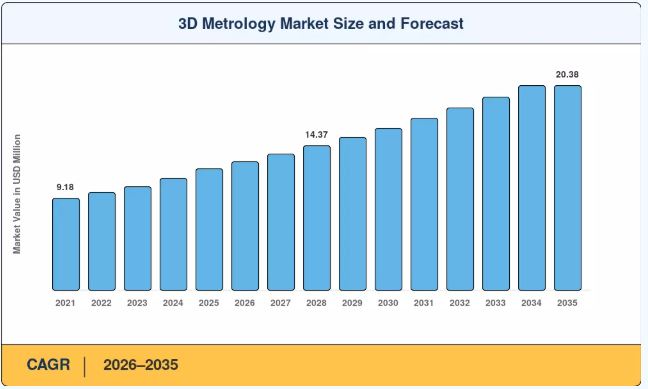
3D metrology market
3D Metrology Market Size, Share and Research Report By Component (Hardware, Software, Services), By Hardware Type (Coordinate Measuring Machine, Laser Trackers
3D Metrology Market is advancing precision measurement technologies that enable accurate quality inspection, reverse engineering, and manufacturing optimization across industries.”
BERLIN, BERLIN, GERMANY, June 18, 2026 /EINPresswire.com/ -- The Global 3D metrology market reached an estimated USD 12.07 billion in 2025 and is projected to grow from USD 12.79 billion in 2026 to USD 20.38 billion by 2035, registering a CAGR of 5.98% during the forecast period. — Market Research Future (MRFR)
Two major catalysts are driving this trajectory: the accelerating adoption of Industry 4.0 manufacturing frameworks that mandate closed-loop, in-line dimensional quality control across automotive, aerospace, and electronics production environments, and the rapid commercial maturation of structured-light scanning, laser tracker, and computed tomography (CT) metrology systems that now deliver sub-micron measurement accuracy at production-floor speeds previously achievable only in controlled metrology laboratories. With global manufacturing quality inspection spending exceeding USD 12 billion annually, 3D metrology has become a mission-critical component of advanced production systems worldwide.
Legacy coordinate measuring machine (CMM) workflows and manual dimensional inspection protocols are giving way to non-contact optical scanning systems, portable articulated arm CMMs, and AI-driven automated defect detection platforms that integrate directly into digital twin and manufacturing execution system (MES) architectures.
A recent Deloitte advanced manufacturing survey estimated that facilities deploying inline 3D metrology reduced scrap and rework costs by 18–24% and compressed first-article inspection cycle times by over 60% compared with facilities relying on offline sampling-based inspection. This transformation is not incremental it reflects a structural shift in how dimensional quality is assured across the entire product lifecycle from prototype validation through high-volume serial production.
Get Full PDF Sample Copy of Report: (Including Full TOC, List of Tables & Figures, Chart) @
https://www.marketresearchfuture.com/sample_request/3677
✿ How Significant Is the 3D Metrology Market’s Growth?
The 3D metrology market has demonstrated robust and sustained expansion, rising from approximately USD 10.2 billion in 2021 to an estimated USD 12.07 billion in 2025, underpinned by surging demand for precision manufacturing quality assurance across automotive electrification programs, aerospace component production, and semiconductor packaging inspection.
The market is projected to more than double over the next decade, driven by the widespread integration of 3D measurement systems into smart factory architectures, the rapid proliferation of additive manufacturing requiring comprehensive geometric verification, and the growing adoption of digital twin platforms that depend on high-fidelity dimensional data as their foundational input.
The transition to electric vehicle (EV) platforms has become one of the most powerful structural demand drivers in the market. EV battery module assembly, electric motor stator winding inspection, and precision casting verification for lightweight structural components all require measurement capabilities at tolerances and throughput rates that exceed traditional CMM capacity.
Meanwhile, the aerospace sector’s accelerating adoption of composite structures, additive-manufactured engine components, and complex curved surface geometries is creating demand for full-field 3D scanning solutions capable of capturing complete geometric datasets not just discrete point measurements across large, complex part envelopes.
✿ What Does the Future Hold for the 3D Metrology Market?
Artificial intelligence and machine vision integration stand at the forefront of the market’s next growth phase. AI-enhanced 3D metrology platforms are evolving from passive measurement instruments into active quality intelligence systems capable of autonomous defect classification, statistical process control feedback, and predictive tooling wear analysis. Deep learning models trained on large geometric datasets can now identify dimensional anomalies, surface finish deviations, and assembly tolerance violations in real time — enabling manufacturing lines to self-correct before non-conforming parts are produced at scale.
The integration of 3D metrology into digital twin ecosystems is another defining force shaping the market’s future. As-built digital twins — geometric models that continuously reflect actual manufactured dimensions rather than nominal design intent — are becoming fundamental tools for predictive maintenance, virtual assembly simulation, and lifecycle performance modeling across aerospace, defense, and precision machinery sectors. 3D metrology systems serve as the primary data acquisition layer feeding these digital twin models, creating structural, mission-critical demand that extends well beyond traditional quality control applications.
Portable and robotic metrology systems are redefining deployment flexibility across the market. Laser trackers, handheld structured-light scanners, and robot-mounted vision inspection cells are displacing fixed-installation CMM rooms for an expanding range of applications enabling in-situ measurement of large assemblies on the shop floor, automated 100% inspection of production parts, and rapid dimensional verification during field service and maintenance operations. The convergence of collaborative robot (cobot) technology with 3D scanning payloads is expected to dramatically expand the addressable market for automated metrology in medium and small-batch production environments.
✿ Who Are the Key Players in the 3D Metrology Market?
The 3D metrology landscape is characterized by a mix of established precision instrumentation conglomerates, specialized metrology technology developers, and emerging AI-native inspection platform companies. Key participants shaping the competitive dynamics include:
➤Hexagon AB — the global market leader in metrology and manufacturing intelligence, offering a comprehensive portfolio spanning CMMs, laser trackers, structured-light scanners, and integrated SMART factory software platforms
➤Zeiss Industrial Metrology — delivering precision CMM systems, optical 3D scanners, and industrial CT metrology solutions with a strong presence in automotive, aerospace, and medical device manufacturing
➤Faro Technologies — providing portable 3D measurement solutions including laser trackers, arm CMMs, and Focus laser scanners widely used in large-volume aerospace and automotive manufacturing
➤Nikon Metrology — offering a broad portfolio of CMM systems, laser radar, X-ray CT, and vision measuring systems with deep expertise in semiconductor and precision component inspection
➤Renishaw plc — a precision engineering leader delivering CMM probing systems, encoder technology, additive manufacturing metrology solutions, and in-process gauging systems
➤Keyence Corporation — providing high-speed optical CMMs, laser profilers, and 3D vision measurement systems widely deployed in electronics, automotive, and consumer goods manufacturing
➤Creaform (AMETEK) — specializing in portable handheld and automated 3D scanning solutions, including the Go!SCAN and MetraSCAN product lines, used extensively in aerospace MRO and tooling verification
➤Perceptron (Atlas Copco) — delivering automated in-line 3D measurement solutions for automotive body-in-white assembly, powertrain inspection, and final vehicle dimensional verification
➤GOM (Zeiss Group) — pioneering industrial photogrammetry and structured-light scanning with the ATOS and TRITOP systems, setting benchmarks for full-field surface inspection accuracy
➤Mitutoyo Corporation — a global precision measurement leader offering CMMs, vision measuring systems, and form measurement instruments with extensive deployment across Asia-Pacific manufacturing markets
Competition in the market is intensifying as vendors race to embed AI-powered defect classification, automated GD&T analysis, and cloud-connected measurement data management into their platforms, while simultaneously developing robot-mountable and cobot-compatible scanning payloads that lower the barrier to automated metrology deployment. Strategic acquisitions of software analytics companies and additive manufacturing inspection specialists are reshaping competitive positioning across the vendor landscape.
✿ What Are the Emerging Trends in the 3D Metrology Market?
Several transformational trends are redefining how the 3D metrology market evolves through 2035:
AI-Powered Automated Defect Detection: Deep learning models integrated with 3D point cloud data are enabling autonomous identification and classification of geometric defects, surface anomalies, and tolerance violations reducing human inspector dependency and enabling 100% automated part inspection at production-line speeds.
Inline & In-Process Metrology Expansion: The shift from offline sampling-based inspection to fully inline, 100% measurement integrated directly into production cells is accelerating across automotive, electronics, and aerospace sectors driven by zero-defect manufacturing mandates and EV production quality requirements.
Industrial CT & X-Ray Metrology Growth: Computed tomography metrology is expanding rapidly for internal geometry inspection of additive manufactured parts, composite structures, and multi-material assemblies where surface-only scanning cannot capture critical internal dimensional features and porosity characteristics.
Digital Twin Integration: 3D metrology systems are becoming the primary as-built data acquisition layer for digital twin platforms, enabling continuous geometric model updating, virtual assembly simulation, and predictive lifecycle performance analysis across aerospace, defense, and precision machinery industries.
Robotic & Cobot-Mounted Scanning: Collaborative robot platforms equipped with 3D scanning payloads are enabling flexible, reconfigurable automated inspection cells that can adapt to changing part geometries and production volumes making automated metrology economically viable for medium and small-batch manufacturing environments.
Semiconductor & Electronics Miniaturization Demands: The rapid shrinking of semiconductor packaging geometries, PCB feature sizes, and microelectronic assembly tolerances is driving demand for sub-micron and nanometer-range 3D measurement systems capable of characterizing features at scales that exceed conventional optical CMM resolution limits.
Get access to the full description of the report @
https://www.marketresearchfuture.com/reports/3d-metrology-market-3677
✿ How Is the 3D Metrology Market Segmented?
The 3D metrology market report provides a comprehensive segmentation framework:
By Equipment Type: Coordinate Measuring Machines (CMM), Optical Digitizers & Scanners, Video Measuring Machines (VMM), Form Measurement Systems, X-Ray & CT Systems, Others
By Offering: Hardware, Software, Services (Calibration, Training, Maintenance)
By Application: Quality Control & Inspection, Reverse Engineering, Virtual Simulation, R&D & Prototyping, Others
By End-Use Industry: Automotive, Aerospace & Defense, Electronics & Semiconductors, Medical Devices, Heavy Machinery & Equipment, Energy & Power, Others
By Organization Size: SMEs, Large Enterprises
✿ What Are the Regional Insights from the 3D Metrology Market?
North America commands approximately 35% of global 3D metrology market share, underpinned by the world’s largest aerospace and defense manufacturing base, a rapidly expanding EV and advanced automotive production ecosystem, and strong adoption of Industry 4.0 smart factory frameworks across major industrial manufacturers. The United States accounts for the dominant share of regional revenue, driven by Boeing, Lockheed Martin, and General Electric’s extensive metrology infrastructure investments, alongside tier-1 automotive supplier networks in Michigan, Ohio, and the Southern automotive corridor deploying inline 3D measurement for EV powertrain and battery module production.
Europe holds the second-largest share at approximately 29%, with Germany, France, the United Kingdom, and Italy representing the primary markets. Germany’s premium automotive OEM and supplier ecosystem including BMW, Mercedes-Benz, Volkswagen Group, and their extensive tier-1 supply chains drives substantial 3D metrology demand for both new model development and high-volume production quality assurance. The presence of global metrology market leaders including Zeiss, Hexagon’s European operations, and Renishaw in the UK further reinforces Europe’s position as both a major market and a center of metrology technology innovation.
Asia-Pacific represents the fastest-growing region, projected to register a CAGR of approximately 11.2% through 2035, driven by China’s massive automotive and electronics manufacturing base, Japan’s precision machinery and semiconductor equipment sectors, South Korea’s display and semiconductor industries, and India’s rapidly expanding aerospace and automotive manufacturing capabilities.
China alone is projected to account for over 22% of global 3D metrology demand by 2030, supported by government-driven manufacturing quality upgrading initiatives under the Made in China 2025 framework and aggressive domestic EV production expansion.
The Middle East & Africa region is an emerging growth market, driven primarily by aerospace MRO investment in the UAE, Saudi Arabia’s Vision 2030 industrial diversification programs that include advanced manufacturing and defense production capabilities, and South Africa’s established automotive manufacturing sector. Investment in local precision manufacturing infrastructure across GCC states is creating incremental demand for 3D metrology systems as regional manufacturers seek to reduce dependence on foreign quality assurance services.
Latin America rounds out the global picture, with Brazil and Mexico representing the most active markets. Mexico’s deep integration into North American automotive supply chains producing over 3.7 million vehicles annually is driving sustained demand for production-floor 3D metrology across automotive OEM and tier-1 supplier facilities, while Brazil’s aerospace sector, anchored by Embraer and its extensive supplier network, maintains significant investment in advanced dimensional measurement and reverse engineering capabilities.
➤➤➤ Industry Analysis Reports by Market Research Future:
Rf Transceiver Market -
https://www.marketresearchfuture.com/reports/rf-transceiver-market-5760
Iot Microcontroller Market -
https://www.marketresearchfuture.com/reports/iot-microcontroller-market-5888
Nanoelectronics Market -
https://www.marketresearchfuture.com/reports/nanoelectronics-market-6085
Thermal Imaging Market -
https://www.marketresearchfuture.com/reports/thermal-imaging-market-6277
Wearable Display Market -
https://www.marketresearchfuture.com/reports/wearable-display-market-6280
Massive Mimo Market -
https://www.marketresearchfuture.com/reports/massive-mimo-market-6361
Ingestible Sensor Market -
https://www.marketresearchfuture.com/reports/ingestible-sensor-market-6695
Smart Smoke Detector Market -
https://www.marketresearchfuture.com/reports/smart-smoke-detector-market-6957
Network Security Appliance Market -
https://www.marketresearchfuture.com/reports/network-security-appliance-market-7054
Real Time Payment Market -
https://www.marketresearchfuture.com/reports/real-time-payment-market-7060
Sagar Kadam
Market Research Future
+1 628-258-0071
email us here
Visit us on social media:
LinkedIn
Facebook
X
Legal Disclaimer:
EIN Presswire provides this news content "as is" without warranty of any kind. We do not accept any responsibility or liability for the accuracy, content, images, videos, licenses, completeness, legality, or reliability of the information contained in this article. If you have any complaints or copyright issues related to this article, kindly contact the author above.
