

Smart Home Market Insights Report Analyzing Demand Trends And Competitive Positioning

Smart Home Market
Smart Home Market

Smart Home Market
The Business Research Company’s Smart Home Global Market Report 2026 – Market Size, Trends, And Forecast 2026-2035
LONDON, GREATER LONDON, UNITED KINGDOM, October 28, 2026 /EINPresswire.com/ -- The smart home sector is rapidly evolving as technology and consumer demand intersect to create increasingly intelligent and connected living environments. This expanding market is characterized by fierce competition among major players and innovative advancements that enhance convenience, energy management, and security. Let’s explore the current landscape, key growth drivers, leading companies, and market trends shaping the future of smart homes.
Market Size and Growth Outlook for the Smart Home Market
The smart home market is forecasted to surpass $479 billion by 2030, demonstrating a remarkable compound annual growth rate (CAGR) of 22% leading up to that year. Within the wider Electrical and Electronics industry, expected to reach $5,579 billion by 2030, smart home solutions will represent nearly 9% of the total market value. This rapid expansion highlights the increasing adoption of connected technologies and integrated home automation systems worldwide.
Request A Free Sample Of The Smart Home Market Report
https://thebusinessresearchcompany.com/sample_request?id=57977922&type=smp&name=Smart%20Home%20Market%20Report%202026&utm_source=EINPresswire&utm_medium=Paid&utm_campaign=Oct_PR
Major Segment Breakdown Within the Smart Home Market
Among product categories, security and access control is poised to be the dominant segment by 2030, accounting for 27% of the market or approximately $130 billion. This growth is driven by heightened concerns around residential safety, the proliferation of smart locks, video doorbells, and connected surveillance cameras, innovations in facial recognition and edge video analytics, and enhancements in real-time alerts and emergency response integration. The segment benefits greatly from improved interoperability enabled by unified communication standards.
How the Smart Home Market Is Organized by Components and Technology
The smart home market is segmented by components into software, services, and hardware, addressing all facets of connected home technology. Additionally, sales channels fall into direct and indirect categories, reflecting diverse distribution strategies. From a technology standpoint, the market divides into wireless and cellular network-based solutions, both playing vital roles in delivering connectivity and control.
Access The Detailed Smart Home Market Report Here
https://thebusinessresearchcompany.com/report/smart-home-market-report?utm_source=EINPresswire&utm_medium=Paid&utm_campaign=Oct_PR
Key Factors Accelerating Smart Home Market Expansion
Widespread adoption of home automation and IoT devices is a primary factor driving market growth. More households are integrating connected lighting, security systems, appliances, and climate controls that enhance convenience. The improvement of device interoperability and centralized mobile applications has simplified user experiences, while more affordable smart products have broadened accessibility in both developed and emerging markets. This trend is expected to contribute about 1.5% annual growth to the market.
Growing Emphasis on Energy Efficiency and Sustainable Living
Another important growth driver is the increasing focus on reducing energy consumption and promoting sustainable lifestyles. Smart thermostats, automated lighting controls, and energy monitoring devices optimize usage through real-time feedback and automation. Government incentives, stricter efficiency regulations, and rising energy costs further encourage the adoption of these technologies. This factor is estimated to add roughly 1.0% to yearly market growth.
Increasing Demand for Enhanced Home Security and Remote Monitoring
Concerns over safety, theft, and property surveillance are propelling the use of connected cameras, smart locks, video doorbells, motion sensors, and alarms that homeowners can monitor remotely via smartphones. Advanced AI analytics, instant alerts, and cloud-based monitoring platforms improve the effectiveness of these systems. This driver contributes around 0.8% growth annually to the market.
Regional Market Leaders and Growth Rates in the Smart Home Industry
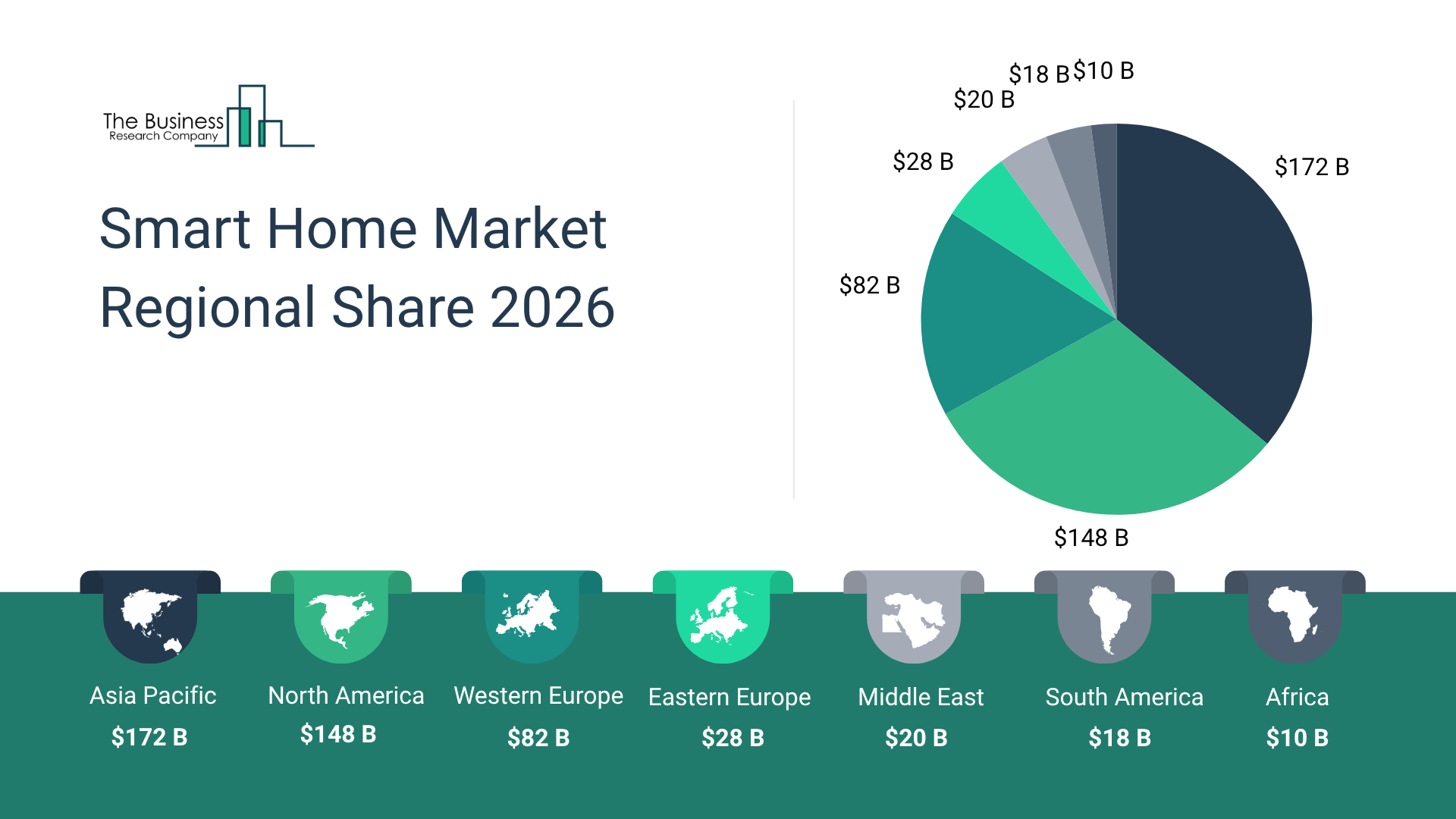
By 2030, the Asia-Pacific region is expected to be the largest smart home market, valued at $172 billion up from $53 billion in 2025, with a strong CAGR of 27%. This rapid growth is fueled by booming residential construction, widespread broadband and 5G access, government support for energy-efficient housing, increasing consumer interest in remote monitoring, and thriving technology ecosystems across countries such as China, Japan, South Korea, India, and Southeast Asia.
Country-Level Market Highlights with the USA at the Forefront
The United States will remain a top smart home market, reaching $127 billion by 2030 from $52 billion in 2025, growing at a CAGR of 20%. This growth will be supported by broad adoption of connected home ecosystems, increasing demand for intelligent security and surveillance tools, integration of voice assistants, investments in home energy management, widely available interoperable platforms, and continuous innovation in connected living technologies.
Who Are the Major Players Leading the Smart Home Market in 2025?
Alphabet Inc. (Google LLC) topped global smart home sales in 2025, holding a 4% market share. Its devices and services division offers a range of smart home products including speakers, displays, security devices, thermostats, automation platforms, and voice-enabled solutions that facilitate connected living and intelligent home management.
Key Competitors and Market Fragmentation Dynamics
The smart home market is moderately fragmented, with the top 10 companies collectively generating just 22% of total revenue in 2025. This split reflects moderate barriers to entry related to technology compatibility, cybersecurity, ongoing device innovation, and the need for scalable, secure applications. Leaders maintain their positions through broad product portfolios, strategic partnerships, extensive distribution networks, and continuous innovation in automation, security, and energy management. As AI-powered automation and interoperable IoT ecosystems become more critical, collaborations and regional expansion will likely strengthen their market shares.
Market Share Breakdown of Leading Smart Home Companies in 2025
The top companies and their approximate market shares are as follows: Alphabet Inc. (Google LLC) and Amazon.com Inc. each hold roughly 4%, Apple Inc. has 3%, Samsung Electronics and ABB Ltd. claim 2% each, General Electric Company also holds 2%, while Honeywell International Inc., ADT Inc., Schneider Electric SE, and Legrand SA each possess about 1%.
Competitive Strategies Among Leading Smart Home Firms
Industry leaders are focused on building integrated smart home ecosystems to enhance automation, utilizing IoT solutions to improve home efficiency, expanding connected living platforms for greater control, and adopting AI to elevate both automation and security capabilities.
Impact of Wireless Automation on Smart Home Market Development
Wireless home automation is significantly transforming the smart home landscape by simplifying installation processes, boosting connectivity, and enabling scalable device management. For example, in February 2026, ABB Ltd. introduced ABB-free@home wireless with system access point 3.0, offering flexible smart home control and seamless integration with other ecosystems. These innovations provide secure remote access, smooth interoperability, and scalable automation, improving convenience and connectivity in residences.
Top Smart Home Product Segments Projected to Drive Value by 2030
The smart home market includes eight key product segments: lighting control, security and access control, HVAC control, entertainment and other controls, smart speakers, smart kitchens, home appliances, and smart furniture. Collectively, these categories are expected to add over $305 billion to the market’s value by 2030. Between 2025 and 2030, lighting control will grow by $35 billion, security and access control by $89 billion, HVAC control by $38 billion, entertainment controls by $18 billion, smart speakers by $45 billion, smart kitchens by $20 billion, home appliances by $53 billion, and smart furniture by $7 billion. Growth is fueled by more affordable sensors and devices, predictive automation, demand for cross-device compatibility, home energy optimization, subscription services, and ongoing innovation in connected living.
Supply Chain Players Distributing Smart Home Technology to End Users
Major suppliers of raw materials and components in the smart home sector include companies like Samsung Electronics, LG Electronics, Panasonic, Sony, Schneider Electric, Siemens, Honeywell, ABB, Legrand, Koninklijke Philips, and Bosch, along with semiconductor firms such as Texas Instruments, Qualcomm, NXP Semiconductors, STMicroelectronics, Infineon, Analog Devices, Microchip Technology, Murata Manufacturing, Broadcom, Intel, MediaTek, Renesas, Toshiba, and Omron.
Leading wholesalers and distributors supporting smart home product availability include Arrow Electronics, Avnet, Digi-Key Electronics, Mouser Electronics, Future Electronics, RS Group, Farnell Global, TTI, Allied Electronics, Ingram Micro, TD SYNNEX, Tech Data, ScanSource, D&H Distributing, Exclusive Networks, Westcon Group, ALSO Holding, Esprinet, Bechtle, Redington, Mindware, Logicom, ASBIS, EET Group, and Macnica.
On the consumer and enterprise side, major end users consist of Amazon, Apple, Google, Xiaomi, IKEA, Walmart, The Home Depot, Lowe’s, Costco, Best Buy, Target, Alibaba, JD.com, Bunnings, Kingfisher, Carrefour, Tesco, Aeon, Reliance Retail, Lowe’s Smart Home Solutions, Vivint, ADT, Alarm.com, Ring, Ecobee, among others, illustrating the broad ecosystem involved in bringing smart home technologies into everyday life.
Key enhancements in our 2026 market reports include:
• Market attractiveness scoring and analysis
• Total addressable market (TAM) analysis
• Company scoring matrix graphics and tables
• Excel-based forecasting dashboards
• Market hotspots infographics
• Key technologies and future trend analysis
• Updated graphics and tables
Learn More About The Business Research Company
The Business Research Company (www.thebusinessresearchcompany.com) is a leading market intelligence firm renowned for its expertise in company, market, and consumer research. We have published over 30,000+ reports across 27 industries and 60+ geographies. Our research is powered by 1,500,000 datasets, extensive secondary research, and exclusive insights from interviews with industry leaders.
We provide continuous and custom research services, offering a range of specialized packages tailored to your needs, including Market Entry Research Package, Competitor Tracking Package, Supplier & Distributor Package and much more.
Disclaimer: Please note that the findings, conclusions and recommendations that TBRC Business Research Pvt Ltd delivers are based on information gathered in good faith from both primary and secondary sources, whose accuracy we are not always in a position to guarantee. As such TBRC Business Research Pvt Ltd can accept no liability whatever for actions taken based on any information that may subsequently prove to be incorrect. Analysis and findings included in TBRC reports and presentations are our estimates, opinions and are not intended as statements of fact or investment guidance.
Contact Us:
The Business Research Company
Americas +1 310-496-7795
Europe +44 7882 955267
Asia & Others +44 7882 955267 & +91 8897263534
Email: marketing@tbrc.info
Follow Us On:
LinkedIn: https://in.linkedin.com/company/the-business-research-company
Oliver Guirdham
The Business Research Company
7882 955267
Visit us on social media:
LinkedIn
Facebook
X
Legal Disclaimer:
EIN Presswire provides this news content "as is" without warranty of any kind. We do not accept any responsibility or liability for the accuracy, content, images, videos, licenses, completeness, legality, or reliability of the information contained in this article. If you have any complaints or copyright issues related to this article, kindly contact the author above.
