

Sixthfin Releases Financial Close Automation Software Buyer Criteria 2026: Eleven Ways UK Enterprises Can Compare Close Software Vendors on Reliability of Accounts
Sixthfin sets out eleven financial close automation software evaluation criteria for UK enterprise finance and procurement teams, covering multi-entity scalability, ERP coverage, data harmonisation, account analysis and justification, analytical review, transaction level drill-down, anomaly identification, audit evidence, control standardisation and implementation requirements, so that close software RFPs and vendor comparisons are built around the reliability of the accounts produced rather than feature lists or the length of the close
London, United Kingdom, Oct. 28, 2026 (GLOBE NEWSWIRE) -- Financial close software evaluations often begin with a feature list. The harder question tends to arrive after go-live, when the close finishes on time and someone still asks whether the numbers can be explained. Sixthfin, a financial data control and financial close technology company with offices in London and Paris, has set out eleven criteria for enterprise finance and procurement teams comparing close automation software, intended to put the reliability of the accounts at the centre of that comparison. For more information, visit https://sixthfin.com/en/solution/closing/
The eleven criteria are enterprise scalability, multi-entity capability, ERP coverage, data harmonisation, account analysis and justification, analytical review, transaction level drill-down, anomaly identification, audit evidence, control standardisation and implementation requirements. Financial close software covers substantially different capabilities, and an organisation that scores vendors on feature counts can complete a procurement, deploy successfully and discover a year later that it bought coordination when the problem was review.
Sixthfin's research among UK finance leaders shows why the distinction matters. In the Sixthfin Report on Accounting Transformation, a study of 303 CFOs at large and mid-sized private UK companies conducted by Odoxa for Sixthfin and published in May 2026, 67% named improving the reliability of accounts as their top priority for improving the close, and only 42% described the way their organisation manages the close as very satisfactory. The full study is available at https://sixthfin.com/en/resource/sixthfin-report-on-accounting-transformation/
The first criteria concern the finance estate a platform has to work across. Multi-entity scalability comes first. A platform intended for a multinational organisation has to accommodate differences between subsidiaries while giving group finance consolidated visibility over close progress, account justifications, accounting reviews, exceptions and supporting evidence.
ERP coverage matters most where acquisitions, regional technology decisions and legacy infrastructure have produced a heterogeneous finance environment. Requiring every company to adopt the same ERP and chart of accounts before close processes can be standardised turns a finance initiative into a larger transformation programme. Sixthfin Closing is ERP and chart of accounts agnostic; the company says its technology supports 38 ERP systems and is deployed in more than 70 countries, with data fed through a configured data exchange mechanism. The question for enterprise buyers is therefore not whether close software integrates with an ERP, but whether it can operate across the organisation's actual ERP estate without that estate being replaced first. To learn more visit https://sixthfin.com/en/solution/harmonise-multi-erp-accounting-data/
Data harmonisation follows directly. Large finance departments rarely lack data. The difficulty is that it originates from different entities, systems, charts of accounts, currencies and local accounting practices, and has to be assembled into a homogeneous, controlled and demonstrable financial base before group finance can review it.
“Most close software scorecards reward the vendor with the longest feature list. That tells a CFO very little about whether the accounts can be explained once the period is locked. The criteria we have set out put four questions to every vendor: which accounts were analysed, across what population of data, who reviewed them, and what evidence remains for audit. A platform that cannot answer those four questions has not improved the reliability of the close, however many features it ships,” said François Vallana, CEO of Sixthfin.
The next criteria concern the review itself. Account analysis and justification should be assessed separately from close workflow. Excel is as common as the ERP itself for analysing and justifying accounts, and just 3% of the companies surveyed use a dedicated solution for account reconciliation in the sense of balance sheet substantiation and justification, rather than transaction matching. Analysis and justification of accounts was also the activity CFOs most often wanted to strengthen. Buyers can therefore examine whether account justification is merely tracked as a completed task, or whether the platform structures the review itself, holds the justification alongside the balance and makes it comparable from one period to the next.
Analytical review of the balance sheet and income statement, and the checking and validation of manual entries, followed closely among the activities CFOs want to strengthen. A useful test is whether the platform automates the control itself and applies it across the complete population of accounting data rather than a sample, since anomalies that are individually small can only be seen when the whole population is examined.
Transaction level drill-down becomes important the moment that review identifies an exception. A reporting dashboard can show that a balance has moved; a finance professional still has to establish why. Enterprise buyers can assess whether users move from consolidated information to the underlying journal entries and transactions without exporting into spreadsheets or returning to multiple source systems.
AI is spreading across finance, and evaluations increasingly treat anomaly detection as a differentiator. CFOs in the survey are open to AI but not uncritical, and on every use case tested fewer than half trust it without reservation. The distinction buyers are learning to make is between detection and what surrounds it. A flagged entry is only worth acting on where the team can trace it to the underlying transaction, justify the balance and leave an evidenced review behind. That control-and-evidence layer, not a detection engine, is what Sixthfin Closing provides: automated controls that surface unbalanced or atypical entries, transaction-level drill-down, structured account justification and a traceable, audit-ready review history across a multi-ERP estate.
The final criteria concern evidence and delivery. A completed close task does not in itself demonstrate what was reviewed, which exception was identified, how it was investigated or what supported the conclusion. Closing centralises supporting documentation and maintains a history of accounting reviews alongside the financial information being analysed, providing traceability for finance, internal control, internal audit and external audit teams.
Implementation requirements can change a comparison materially. A platform requiring an ERP migration or a simultaneous group-wide rollout presents a different profile from a close layer introduced around existing systems. Sixthfin says Closing can be deployed in weeks and that deployment can be phased across entities. More than 1,000 companies and groups were covered by Sixthfin technology in 2025.
For procurement teams preparing close software RFPs, scorecards can accordingly extend past functionality and licence cost to ERP coverage, multi-entity scalability, account justification and analytical review capability, audit evidence, implementation dependency, internal IT requirement and deployment risk.
The criteria will not carry the same weight everywhere. A multinational running several ERP systems is likely to prioritise harmonisation, multi-entity control and transaction level investigation. An organisation coordinating an already standardised close may weight workflow and task management more heavily. For UK enterprises evaluating financial close automation in 2026, the more useful question is not which platform has the longest feature list, but whether the technology strengthens the review and control of the accounts the close produces.
For more information about Closing or to request a demonstration, visit https://sixthfin.com/en/solution/closing/balance-sheet-review/
About Sixthfin
Sixthfin develops financial data control and financial close technology for complex organisations. Its Closing platform structures balance sheet reviews, account analysis and justification, control standardisation, collaborative workflows, documentation and transaction level investigation across multi-entity and multi-ERP environments. Sixthfin technology supports 38 ERP systems, is deployed in more than 70 countries and covered more than 1,000 companies and groups in 2025. The company has offices in London and Paris.
Attachment

Cécile Mana
1 Waterhouse Square
London EC1N 2ST, United Kingdom
+44 7 517 614 077

Sixthfin Enterprise Financial Close Automation Software
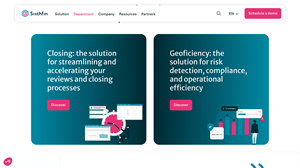
Sixthfin Enterprise Financial Close Management Platform Addresses UK Multi-Entity Groups Running Fragmented ERP Estates, With 38 Systems Supported Across 70 Countries in 2026
Legal Disclaimer:
EIN Presswire provides this news content "as is" without warranty of any kind. We do not accept any responsibility or liability for the accuracy, content, images, videos, licenses, completeness, legality, or reliability of the information contained in this article. If you have any complaints or copyright issues related to this article, kindly contact the author above.
